
Is a grain-free diet for companion pets truly grain-free? Well, not always. There are a few explanations for this.
Contamination or Undeclared Ingredients
A 2010 study evaluated four over-the-counter venison dry dog foods available for the commonly known food allergens of soy, poultry and beef. Three of the four foods with no soy products named in the ingredient list were ELISA positive for soy. The authors concluded cross-contamination – which can happen in any number of ways – was the cause. We agree with this theory but do believe the authors overlooked another potential cause: the feed these deer ate. More on this later.
A study in 2013 investigated hydrolyzed diets. That study did not evaluate for grains, but found contamination in 10 out of the 12 diets analyzed.
A 2021 study inadvertently discovered that many pet foods claiming to be made from high-value ingredients – such as novel proteins and fish – actually contained more low-value ingredients like chicken than high-value ingredients.
What the Protein Ate
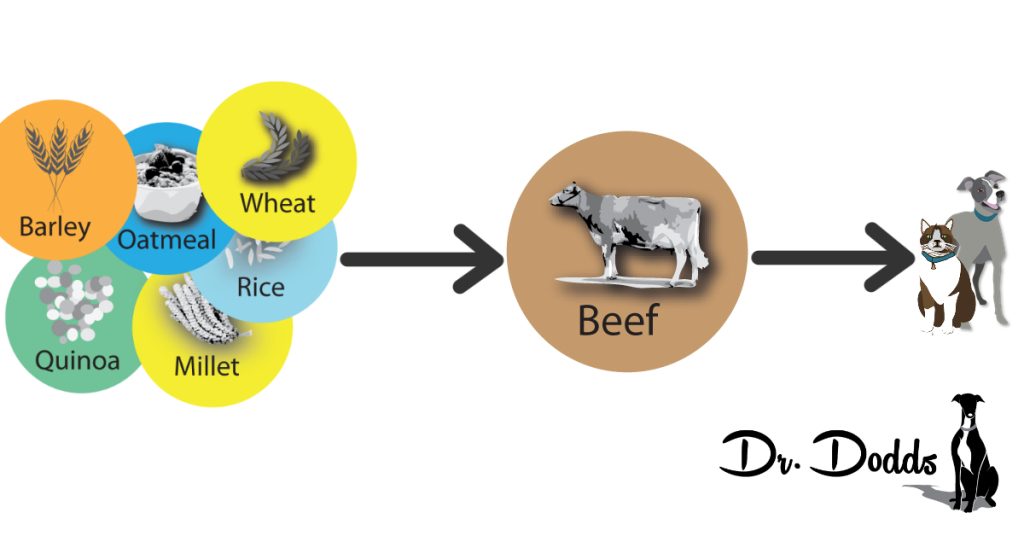
Coupled with adulterated pet food, NutriScan results have demonstrated that to some extent, corn, soy and grains may also still be offending foods for dogs and cats that eat grain-free diets. In essence, these ingredients are still expressed through the animal protein being eaten. For instance, chicken feed is mainly comprised of grains.
Despite popular belief, deer are increasingly commercially raised and are not foraging in the woods for fruits and berries. In fact, a quick Google search showed that soy and corn are ingredients in several deer feeds. So, the 2010 study and NutriScan detected foods that may not be ingredients in the actual formulation, but what is fed to the animal before it was turned into a food protein.
What to do?
Overall, I recommend avoiding corn, wheat and soy in general, if they are listed as ingredients. Additionally, if your pet’s NutriScan test results show a medium or strong reaction to a food, I recommend avoiding it; intermediate food reactions are also best avoided.
References
Dunham-Cheatham, Sarrah M et al. “Using a next-generation sequencing approach to DNA metabarcoding for identification of adulteration and potential sources of mercury in commercial cat and dog foods.” The Science of the Total Environment vol. 778 (2021): 146102. doi:10.1016/j.scitotenv.2021.146102, https://pubmed.ncbi.nlm.nih.gov/33714808/.
Raditic, D M et al. “ELISA testing for common food antigens in four dry dog foods used in dietary elimination trials.” Journal of Animal Physiology and Animal Nutrition vol. 95,1 (2011): 90-7. doi:10.1111/j.1439-0396.2010.01016.x, https://pubmed.ncbi.nlm.nih.gov/21039924/.
Raditic, DM et al. “ELISA testing for common food antigens in four dry dog foods used in dietary elimination trials,” Journal of Animal Physiology & Animal Nutrition; 95 (2013), pp. 90-97, https://pubmed.ncbi.nlm.nih.gov/21039924/.
Ricci, R. et al; “Identification of undeclared sources of animal origin in canine dry foods used in dietary elimination trials,” Journal of Animal Physiology & Animal Nutrition; 97 (2013), pp. 32-38, https://pubmed.ncbi.nlm.nih.gov/23639015/.
Originally Published: February 5, 2014
Updated: May 9, 2024